
The buffered-range model and seeking
Part of SABR in the extractor. This is the subtlest piece of the extractor, and the one most often gotten wrong. It lives in YoutubeSabrStreamState, one FormatProgress per track.
Why two "max" values
The server only sends what the client says it's missing, so the buffered ranges in each request must be honest. The trap is gaps. Suppose segments 1, 2, 3, 5, 6 have arrived but 4 was dropped or lost:
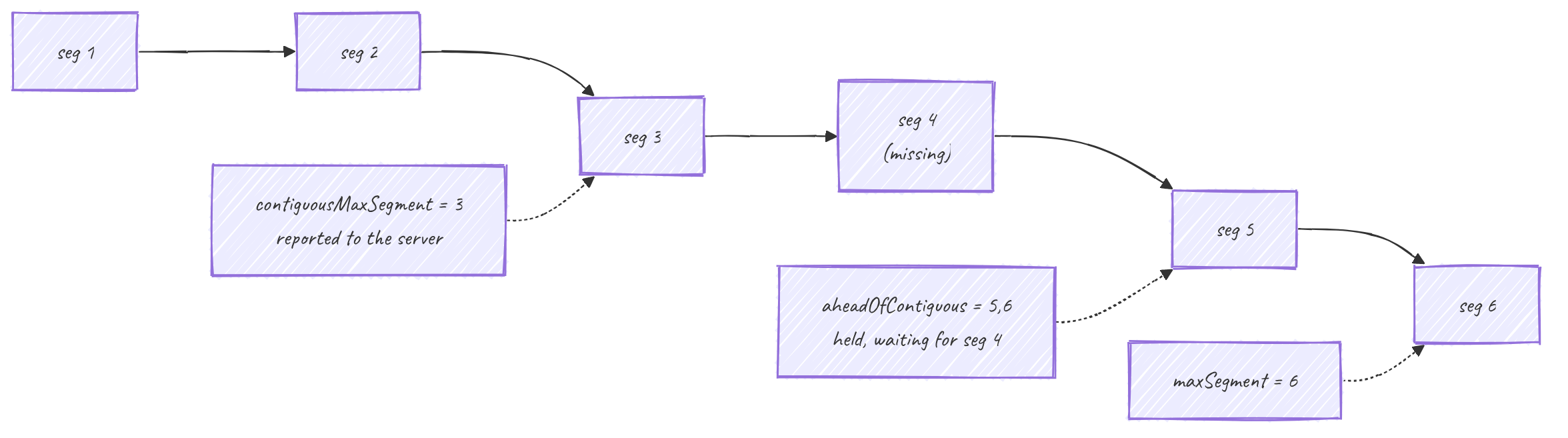
If the client reported maxSegment = 6, the server would assume 1–6 are all held and send segment 7, and segment 4 would never be filled, the sequential reader starves at the hole forever.
So FormatProgress tracks two heads:
contiguousMaxSegment— the highest segment with no gap from the start. This is what's reported to the server, so it always sends the exact next sequential segment a reader needs.maxSegment— the highest segment seen at all (may sit past a hole).aheadOfContiguous— a set of out-of-order segments received past the contiguous edge, waiting to be folded in.
observeHeader(seq) maintains them: if seq == contiguousMaxSegment + 1, advance the contiguous edge and drain aheadOfContiguous as far as it reaches; if seq is further ahead, stash it in aheadOfContiguous. This contiguous-vs-max split is the central anti-starvation mechanism.
The observed-timing window
Alongside the segment numbers, FormatProgress records a timing window from the headers it has actually seen: firstObservedSegment, lastObservedSegment, observedStartMs, observedEndMs, observedMaxSegment, lastObservedDurationMs. Plus endSegment and averageDurationMs (from the format-init metadata) and the parsed segmentIndex.
Building the ranges
getBufferedRanges() emits one SabrBufferedRange per track (or SabrBufferedRange.full(...) if a track is flagged fully buffered, or a manual override). The interesting decision in addBufferedRange is whether to trust the observed timing:
canUseObservedTiming =
       observedStartMs >= 0
    && observedEndMs > observedStartMs
    && observedMaxSegment >= maxSegment
    && firstObservedSegment > 0
    && contiguousMaxSegment >= maxSegment   // the no-hole guard
That last clause is the key: observed timing is only trusted when there is no hole (contiguous has caught up to max). Otherwise the observed end would overstate coverage past the gap. When trusted, the range uses observedStartMs / observedEndMs - observedStartMs and firstObservedSegment; otherwise it falls back to startTime = 0, duration = getBufferedEndMs(), startIndex = 1. Either way endSegmentIndex = contiguousMaxSegment, never maxSegment. And getBufferedEndMs() is computed from contiguousMaxSegment too (a hole means we're not really buffered past it).
Seeking
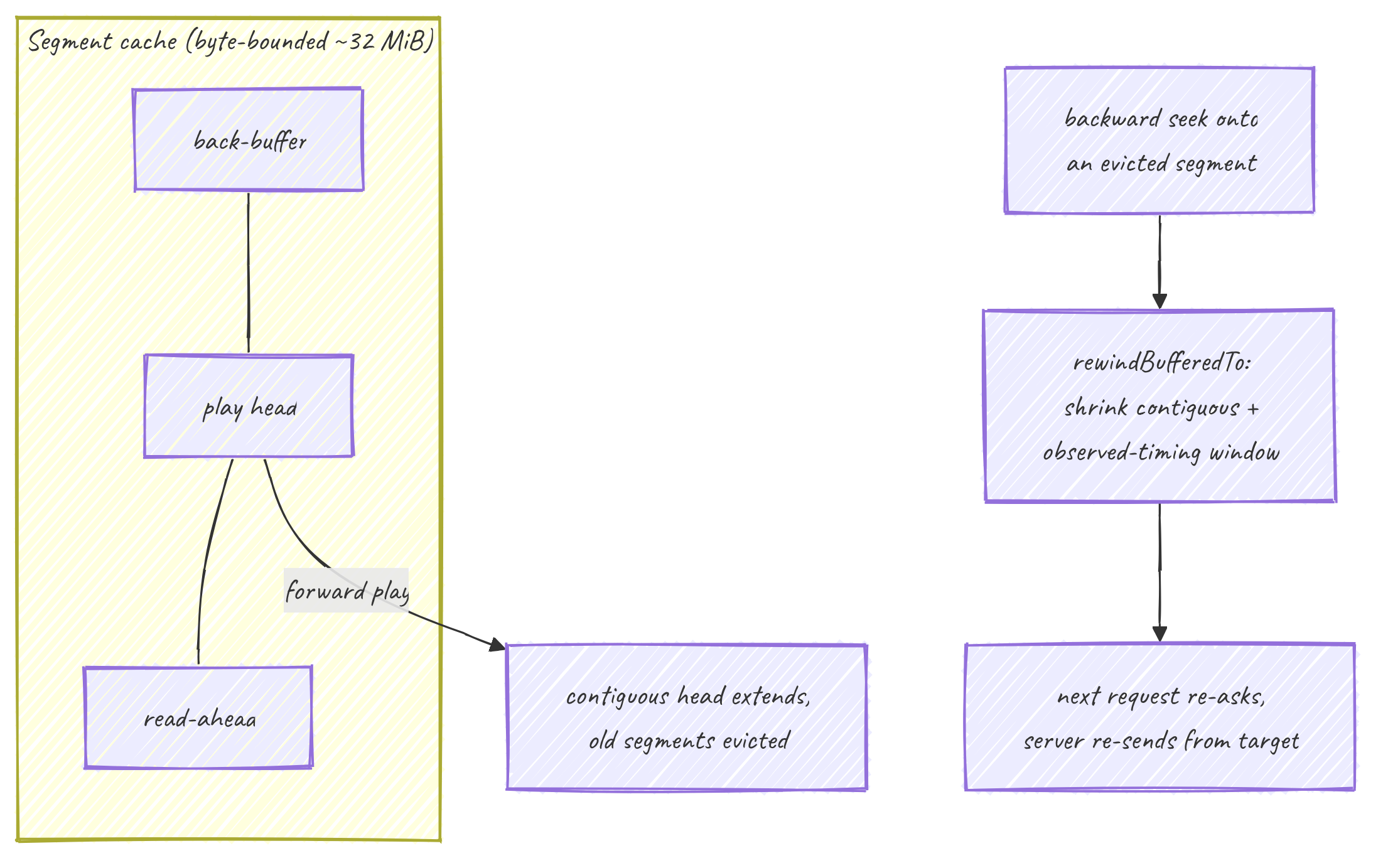
Forward seeks within reach are easy because the model has a forward bias. assumeBufferedUntil(format, seq) only ever raises maxSegment; the session's prepareForMediaSegment / maybePrepareForDistantMediaSegment use it to jump the bookkeeping ahead and let SabrSeek / player time align.
But a distant forward seek (a cold seek far past the buffered edge: a SponsorBlock skip, resume-from-history) is not free. prepareForMediaSegment only raises maxSegment; it leaves contiguousMaxSegment (the segment the reported range actually ends at) behind at the old edge. So the request keeps advertising the old span as buffered, the server keeps filling it, the pump ping-pongs between the old edge and the target, and the reader can wait forever on the far segment. prepareForForwardJump → jumpBufferedTo(fromSegment) is the symmetric counterpart of the rewind below: it moves contiguousMaxSegment onto the target (folding in target-zone segments that already arrived out of order, dropping the observed window), so the server streams from there and the edge-driven pacing follows. A later backward seek into the skipped span goes through prepareForRewind honestly.
Backward seeks are the hard case. After playing forward, the buffered head sits high; a seek back onto an already-received segment would leave the request still advertising that range as buffered, the server sends nothing, the reader stalls. prepareForRewind → rewindBufferedTo(fromSegment) repairs the state precisely:
last = max(0, fromSegment - 1).- Guard: if
last >= contiguousMaxSegment, it isn't a rewind for this track, return. - Otherwise shrink:
maxSegment = last,contiguousMaxSegment = last,observedMaxSegment = min(observedMaxSegment, last). - Drop the observed window:
firstObservedSegment,lastObservedSegment,observedStartMs,observedEndMsall back to-1.
Step 4 matters as much as step 3: if the observed window survived, canUseObservedTiming could still report an end past the seek target and the re-request would again come back empty. With both heads and the observed window walked back, the next request honestly asks for the target and the server re-sends it. The session does this for both the rewound track and its companion (audio/video move together), then sets player time.
Next: The session driver.