
The session driver
Part of SABR in the extractor. YoutubeSabrSession is the state machine that turns the protocol into a stream of playable segments. It owns the chosen audio + video formats, the YoutubeSabrStreamState, the segment cache, the counters, and an optional SabrPoTokenProvider.
A round
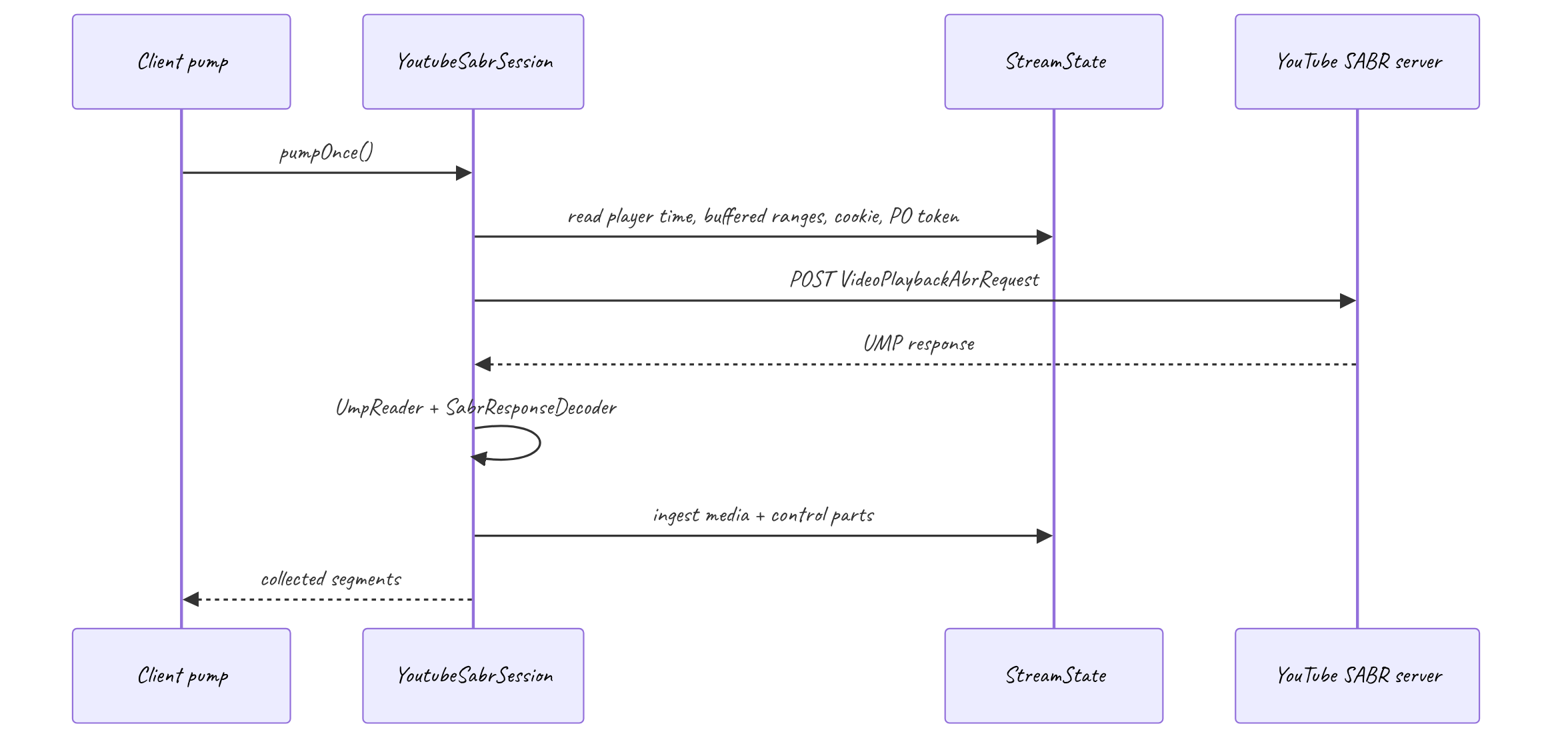
The raw POST is fetchNextResponse: request 0 is the cold start (YoutubeSabrProbe.probeFirstMediaResponse), later ones are follow-ups carrying state. Each result is checked for a redirect (counted, capped, then the streaming URL is swapped) and requestNumber is incremented.
Two driving loops
pumpOnce(localization)is the lenient, server-driven advance: one request, ingest, collect, cache, apply policy, return whatever segments arrived (possibly none). The client calls it in a loop to stay buffered ahead. A singlestatus=3or policy-only round is not fatal here, the client's stall watchdog is the real give-up.fetchSegment(request, localization)is the strict path for "I need exactly this segment": cache hit returns immediately, otherwise it loops up toMAX_REQUESTS_PER_SEGMENT, tolerating a bounded number of policy-only rounds, handling reload/protection/redirect, until the target is cached or it throws.
pumpOnce, step by step
fetchNextResponse(POST, redirect handling,requestNumber++).- If
getIntegrityIssues()is non-empty → throw. streamState.ingest(decoded)(cookie, ranges, policy, live, contexts).SabrMediaSegmentCollector.collect(decoded).- For each segment: ingest into state, put in cache; if new and not an init segment, append to
cacheOrderand add tocachedBytes. evictCacheIfNeeded().- If a
SabrErroris present → throw. - If reload requested →
maybeReload; on success return empty (the pump will call again), else throw. - If
isProtectedNoMediaResponse()(status 3) → best-effort PO token, no throw. - If segments arrived → reset the redirect and PO-token-refresh counters (a media-bearing response proves the token works and the CDN hops are normal, so long sessions aren't capped).
- If a backoff was requested → sleep.
Constants (the bounds)
Every failure mode is bounded:
| Constant | Value | Purpose |
|---|---|---|
MAX_REQUESTS_PER_SEGMENT | 16 | attempts to obtain one specific segment |
MAX_POLICY_ONLY_RESPONSES_PER_SEGMENT | 3 | consecutive no-media rounds tolerated per segment |
MAX_REDIRECTS_PER_SESSION | 3 | CDN redirect hops (reset on a media response and on reload) |
MAX_RELOADS_PER_SESSION | 2 | server-requested player-response reloads |
MAX_PO_TOKEN_REFRESHES | 2 | forced token re-mints before giving up |
MAX_BACKOFF_MS | 30 000 | clamp on honoured server backoff |
MAX_CACHE_BYTES | 32 MiB | media-byte cache budget (~50 s of 4K) |
MIN_CACHED_SEGMENTS | 6 | eviction never drops below this many |
EVICT_BEHIND_MS | 10 000 | back-buffer kept behind the play head |
SEEK_KEEP_WINDOW_MS | 30 000 | cache window kept either side of a seek target |
The cache
A ConcurrentHashMap<String, SabrMediaSegment> keyed itag + ":" + ("init" | sequenceNumber), plus an ArrayDeque of media-segment keys in insertion order and a running cachedBytes. Init segments are cached but never counted and never evicted (they're tiny and always needed). getCachedSegment(request) is a side-effect-free lookup the client's reader hits first. Byte accounting is maintained by pumpOnce (the fetchSegment path caches without touching the accounting).
Eviction
evictCacheIfNeeded() runs every round (even when byte-throttled, otherwise the throttle never releases and playback freezes). While cachedBytes > MAX_CACHE_BYTES and cacheOrder.size() > MIN_CACHED_SEGMENTS, it looks at the oldest segment and:
- if its end time is
> playHeadMs - EVICT_BEHIND_MS, it's within the back-buffer or ahead of the play head → stop (the cache is allowed to ride over budget rather than evict something still needed); - otherwise drop it and subtract its bytes.
playHeadMs is fed in by the client via setPlayHeadMs, this is what makes eviction play-head-aware rather than blindly FIFO. (Seeking, which also lives partly here via prepareForRewind, is covered in the buffered-range model.)
On a seek, byte-budget eviction alone is not enough: a large jump leaves the old span and the freshly fetched target span in the cache, two disjoint regions that together can blow far past MAX_CACHE_BYTES, untenable at 4K segment sizes. evictOutsideSeekWindow(targetMs) collapses the cache to a single window: it drops every media segment whose time falls outside [targetMs - SEEK_KEEP_WINDOW_MS, targetMs + SEEK_KEEP_WINDOW_MS] (init segments excepted) and re-subtracts their bytes, so right after a jump the cache holds only the ±30 s around where playback resumes. It runs on the seek-prep path, next to prepareForRewind / prepareForForwardJump.
Resilience
Within a session the driver contains every way a server can misbehave: bounded redirects, bounded reloads, bounded policy-only rounds, a 30 s backoff clamp, and bounded token re-mints. Redirect and token-refresh budgets reset on any media-bearing round, so a long, healthy session is never killed by accumulated hops. Malformed input throws SabrProtocolException.
Reload (maybeReload) handles SabrReloadPlayerResponse: it re-fetches a fresh YoutubeSabrInfo (new serverAbrStreamingUrl), resets the redirect count, but keeps requestNumber > 0 so the next request is a follow-up carrying the current player time and buffered ranges, it resumes in place rather than restarting.
Protection and tokens
A status=3 no-media response means the server wants a content-bound PO token before releasing media. applyPoTokenForProtectedResponse first tries the cached token (maybeApplyPoToken(false)); if that's already in place and still rejected, and the refresh budget allows, it counts a refresh and forces a fresh mint (maybeApplyPoToken(true)) — a force-refresh triggers a ~45 s WebView mint. The token itself comes from the client via SabrPoTokenProvider.getPoToken(info, streamState, forceRefresh); the extractor only requests, caches (in StreamState), and retries. Minting is the attestation story.
Live
The session exposes isLive(), getLiveHeadSequenceNumber(), and isAtLiveEdge() off the SabrLiveMetadata the state ingests (live-edge sequence within a 2-segment margin, plus DVR state). That's the foundation live playback is built on, client-side.
Next: Control parts reference.