
UMP and decoding
Part of SABR in the extractor. Here: the UMP envelope at the byte level, every part type the decoder knows, and the decoded response.
UMP framing
The response body is UMP (Ultra-Minimal Playback), YouTube's own container, not protobuf at the envelope level (the payloads inside parts are protobuf). UmpReader walks it as a sequence of parts in either of two modes:
readStreaming(InputStream, PartConsumer): read one part (type, size, payload) at a time straight off the network stream and hand it to a consumer, so the whole body is never held at once. Peak transient is a single part's payload instead of the entire response (50-150 MB at 4K). This is the path the session uses for live decoding (see "Streaming the decode" below).readAll(byte[]): walk a single in-memory array and return every part as a list. Handy for small responses and tests, but it needs the whole body buffered first.
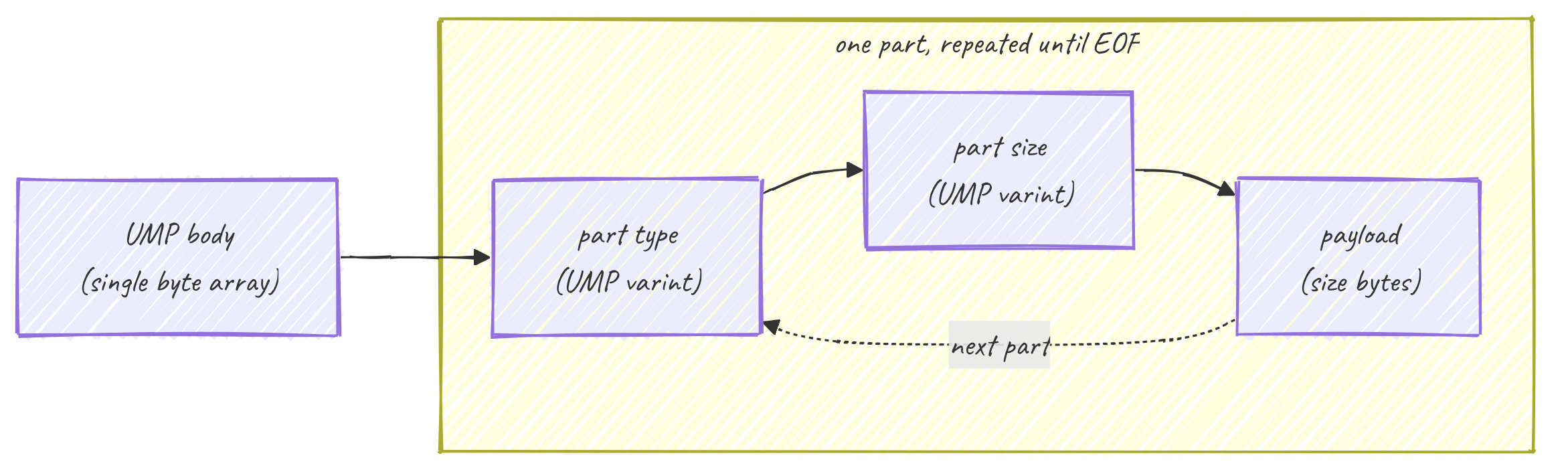
Each part is [type: UMP-varint][size: UMP-varint][payload: size bytes], repeated until EOF (a clean EOF on a part boundary just ends the loop). Neither mode does cross-buffer reassembly of a single part: a part's size bytes are read in full before the next one, and a truncated body throws SabrProtocolException.
The UMP varint
UMP's varint is not protobuf's. The total byte count is decided by the high bits of the first byte:
| First byte | Total bytes | Value |
|---|---|---|
0x00–0x7F (< 128) | 1 | the byte itself |
0x80–0xBF | 2 | (b0 & 0x3f) + 64·b1 |
0xC0–0xDF | 3 | (b0 & 0x1f) + 32·(b1 + 256·b2) |
0xE0–0xEF | 4 | (b0 & 0x0f) + 16·(b1 + 256·(b2 + 256·b3)) |
0xF0–0xFF | 5 | the next 4 bytes, little-endian (the first byte's value bits are discarded) |
The result is a 32-bit signed int; the 5-byte case can overflow negative, which the type < 0 || size < 0 guard rejects, that's the practical cap on part size.
UmpPart holds type, size, and data. getData() returns a defensive clone; an internal getRawData() returns the backing array (used on the hot decode/stitch paths to avoid copying multi-MB segments).
Part types
SabrResponseDecoder dispatches on the part type id. The complete set it recognizes:
| ID | Constant | Decoded into |
|---|---|---|
| 10 | ONESIE_HEADER | SabrOnesieHeader (carried to following onesie parts) |
| 11 | ONESIE_DATA | SabrOnesieData |
| 12 | ONESIE_ENCRYPTED_MEDIA | SabrOnesieData (encrypted) |
| 20 | MEDIA_HEADER | SabrMediaHeader |
| 21 | MEDIA | media bytes (first payload byte = header id) |
| 22 | MEDIA_END | closes a header id |
| 31 | LIVE_METADATA | SabrLiveMetadata |
| 35 | NEXT_REQUEST_POLICY | SabrNextRequestPolicy (sets backoff) |
| 37 | FORMAT_SELECTION_CONFIG | SabrFormatSelectionConfig |
| 42 | FORMAT_INITIALIZATION_METADATA | SabrFormatInitializationMetadata |
| 43 | SABR_REDIRECT | SabrRedirect |
| 44 | SABR_ERROR | SabrError |
| 45 | SABR_SEEK | SabrSeek |
| 46 | RELOAD_PLAYER_RESPONSE | SabrReloadPlayerResponse (sets reloadRequested) |
| 47 | PLAYBACK_START_POLICY | SabrPlaybackStartPolicy |
| 51 | SELECTABLE_FORMATS | SabrSelectableFormats |
| 52 | REQUEST_IDENTIFIER | SabrRequestIdentifier |
| 53 | REQUEST_CANCELLATION_POLICY | SabrRequestCancellationPolicy |
| 57 | SABR_CONTEXT_UPDATE | SabrContextUpdate |
| 58 | STREAM_PROTECTION_STATUS | SabrStreamProtectionStatus (sets status + maxRetries) |
| 59 | SABR_CONTEXT_SENDING_POLICY | SabrContextSendingPolicy |
| 65 | PREWARM_CONNECTION | SabrPrewarmConnection |
| 67 | SNACKBAR_MESSAGE | SabrSnackbarMessage |
Plus generic/known-but-unparsed ids (30 CONFIG, 32–34 live-metadata hints, 36/38 ustreamer metadata, 48–50 cache/bandwidth hints, 54–56, 60–64, 66) which are only summarized, and any unknown id which is recorded via addUnknownPartType. See the control parts reference for what the rich ones do.
The decode loop
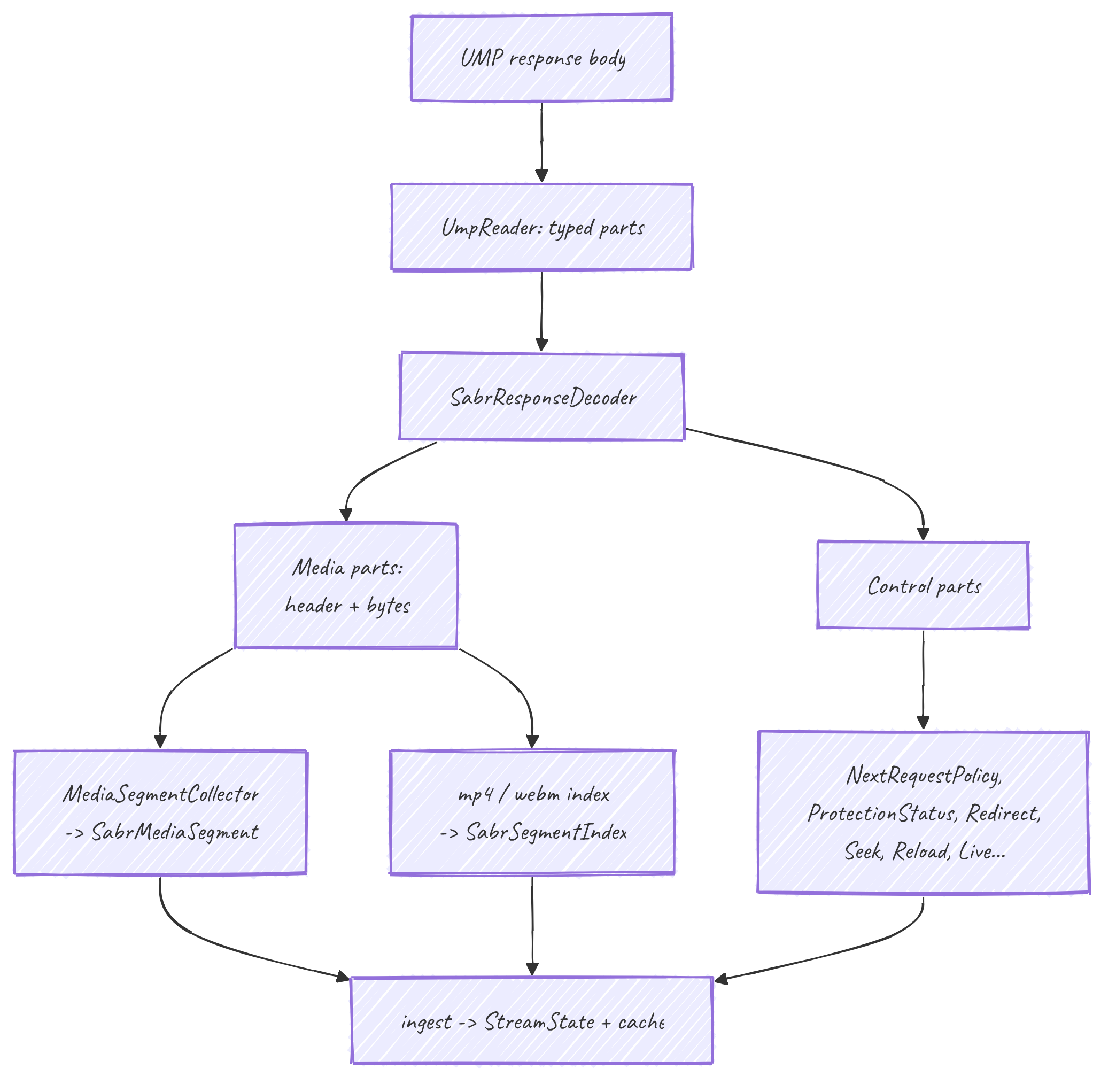
SabrResponseDecoder.decode reads all parts up front, then iterates. The only state carried across parts is the current onesie header (a ONESIE_HEADER applies to the onesie data parts after it). Each part is recorded in order, then dispatched:
- MEDIA_HEADER (20) → decode and register the header.
- MEDIA (21) → the first payload byte is the header id; the remaining length is accumulated as that id's media byte count.
- MEDIA_END (22) → first byte = header id, marks it complete.
- rich control parts → decode into the typed field on
SabrDecodedResponse+ a human summary. NEXT_REQUEST_POLICYgets special handling: after decoding, the backoff is re-read directly from proto field 4 (varint) as the authoritativebackoffTimeMs.
Streaming the decode
SabrResponseDecoder.decode(byte[]) reads every part up front, so the whole body sits in memory. That is fine for small rounds, but a 4K response body runs 50-150 MB, so buffering it whole is a large transient.
SabrStreamingResponseReader.read(InputStream) is the streaming counterpart, for when the body should not be held whole. It drives UmpReader.readStreaming and assembles MEDIA segments on the fly (via SabrMediaSegmentCollector.Incremental), keeping only the small control parts. The big MEDIA payloads become segments as they arrive and are never all retained, so peak memory is a single in-flight segment rather than the whole body. It still tallies per-header-id media byte counts, so the result passes the same getIntegrityIssues() checks as the buffered path without holding the bytes, and returns a Result carrying the assembled segments plus a SabrDecodedResponse built from the control parts.
The decoded response
SabrDecodedResponse holds every part in order plus typed accessors: media headers, per-header-id media byte counts (LinkedHashMap, summed), media-end ids, format-init metadata, live metadata, onesie data, and the single control parts (redirect, seek, error, reload, next-request policy, protection status + max retries, backoff ms, …).
The analysis helpers are what the session branches on:
hasMedia()— any media headers or bytes.isNoMediaResponse()— the inverse.isPolicyOnlyResponse()— no media but a next-request policy (a pure pacing round).isProtectedNoMediaResponse()— no media andstreamProtectionStatus >= 3: the PO-token boundary (status 3 + no media = mint a token).getIntegrityIssues()— cross-checks:duplicate-media-header,missing-media,length-mismatch:expected=…:actual=…,missing-media-end,media-without-header,media-end-without-header. The session treats any non-empty result as fatal.