
The Downloader
The extractor never opens a socket itself. Every network call goes through one abstraction, Downloader, which the host application implements. That keeps the extractor free of any HTTP library and lets the app own cookies, caching, user agents, and proxying.
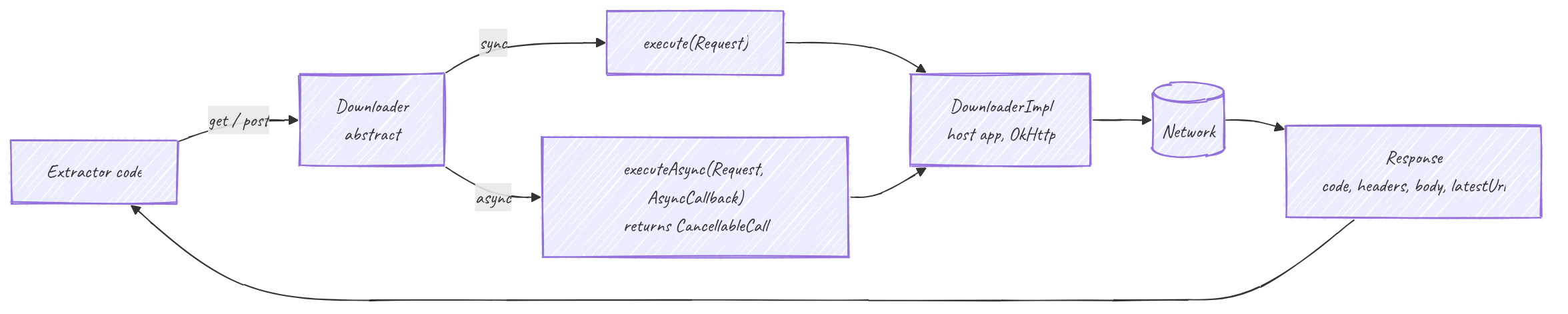
The contract
Downloader is an abstract class. All the convenience methods assemble a Request and funnel into one abstract call:
public abstract Response execute(@Nonnull Request request)
        throws IOException, ReCaptchaException;
The convenience methods are the ones extractors actually call: get(url[, headers][, localization]), head(url), post(url, headers, data[, localization]), options(url, headers). Implement execute and they all work.
Request and Response
Request is built with a builder and is immutable:
Request.newBuilder().get(url).headers(h).build();
Request.newBuilder().post(url, body).setHeader("X-Foo", "bar").localization(loc).build();
Its fields: httpMethod, url, headers, dataToSend, localization, and automaticLocalizationHeader (whether to auto-attach an Accept-Language).
Response is a plain holder:
int responseCode();  String responseMessage();
Map<String, List<String>> responseHeaders();  String getHeader(String name);
String responseBody();  byte[] rawResponseBody();
String latestUrl();   // the final URL after redirects
Async: CancellableCall
Beyond the blocking execute, there is an async path the YouTube extractor leans on to fire several InnerTube requests at once:
public abstract CancellableCall executeAsync(@Nonnull Request request, AsyncCallback callback);
// plus getAsync / postAsync convenience overloads

public interface AsyncCallback {
    void onSuccess(Response response) throws ExtractionException;
    default void onError(Exception e) { e.printStackTrace(); }
}
CancellableCall wraps the underlying call with cancel(), isCancelled(), isFinished(). This is how onFetchPage launches web + android-VR/safari + next concurrently and stitches the results back together (see Extraction flow).
Who provides it
The app installs one concrete downloader at startup via NewPipe.init(downloader). In PipePipeClient that is DownloaderImpl (app/src/main/java/org/schabi/newpipe/DownloaderImpl.java), backed by OkHttp: execute() builds an okhttp3.Request and runs newCall(...).execute(); executeAsync() uses enqueue(...) and wraps the okhttp3.Call in a CancellableCall.
No mock downloader here
Worth knowing if you come from upstream NewPipe: this fork ships no test downloader, no DownloaderFactory, and no recorded mock responses. There is no src/test at all (see Building the extractor). You exercise the extractor by running it against the live services, through the app or a small main() that calls NewPipe.init(...) with a real downloader.