
Inside the YouTube service
YouTube is the largest and most volatile service, and the one most likely to send you into the code. This is the map.
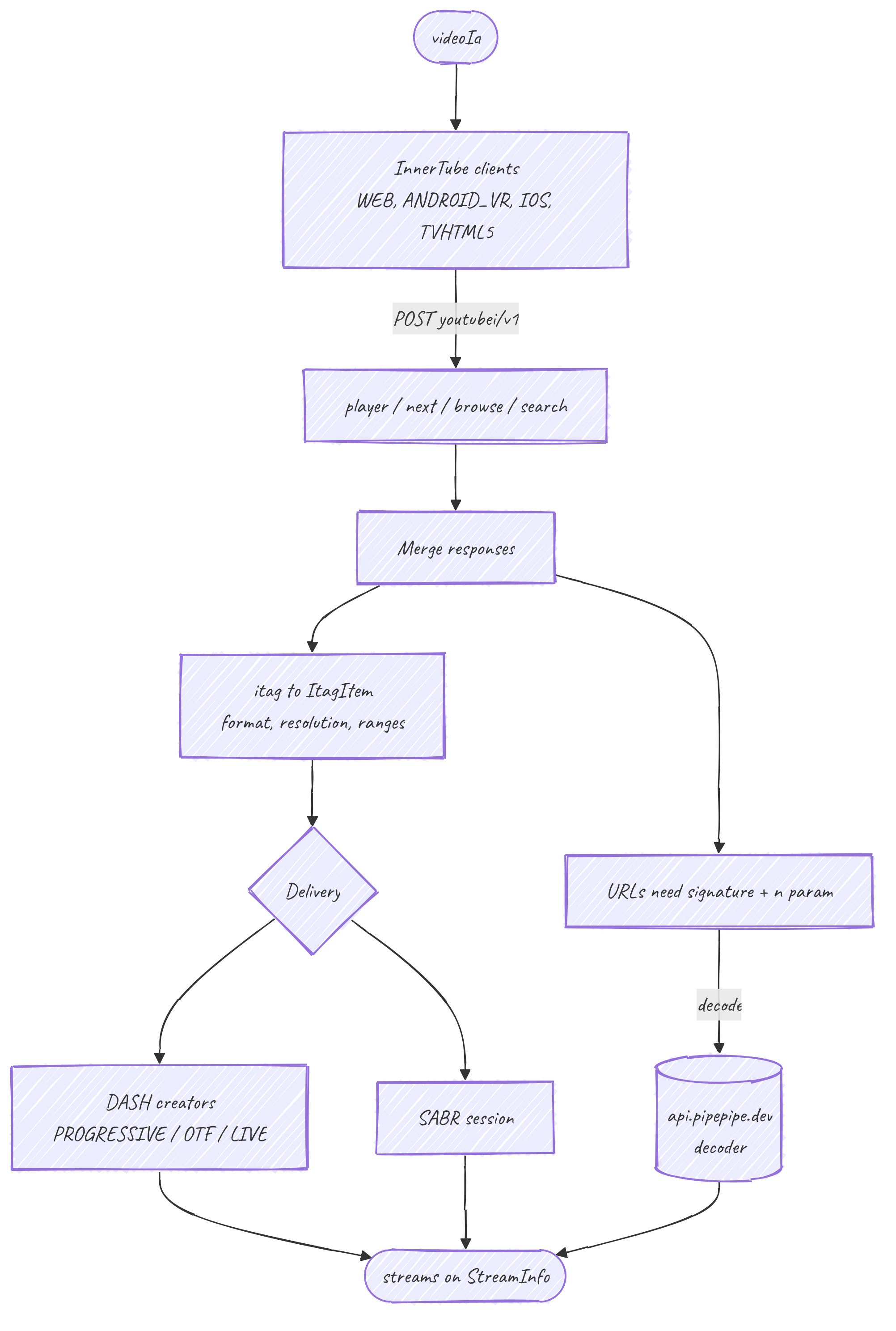
InnerTube clients
There is no public YouTube API here. The extractor speaks InnerTube, YouTube's own internal RPC, by impersonating official clients. Each client is a context block (name, version, platform, device) plus an endpoint. YoutubeParsingHelper builds them:
prepareDesktopJsonBuilder(...)       // WEB
prepareAndroidVRJsonBuilder(...)     // ANDROID_VR (Oculus Quest)
prepareIosMobileJsonBuilder(...)     // IOS
prepareTvHtml5EmbedJsonBuilder(...)  // TVHTML5 embedded
prepareSafariJsonBuilder(...)        // WEB with a Safari user agent
Client ids and versions live in ClientsConstants. Requests POST to youtubei/v1/<endpoint> (player, next, browse, search) through getJsonPostResponse and its android/ios variants. Different clients expose different stream sets and trip different walls, so a single fetch often queries several and merges them, the parallel CancellableCall fan-out from Extraction flow.
Signatures and the n parameter
YouTube protects stream URLs two ways: a scrambled signature, and a throttling n parameter that cripples playback speed if it is not transformed. The usual way to solve both is to download the player base.js and run its JavaScript.
This fork does it differently, and it is the biggest divergence from upstream. Instead of running base.js in Rhino on the device, YoutubeApiDecoder offloads the transform to a PipePipe-hosted service:
YoutubeApiDecoder.decodeSignature(playerId, sig);            // POST api.pipepipe.dev/decoder/decode
YoutubeApiDecoder.decodeThrottlingParameter(playerId, nParam);
YoutubeJavaScriptPlayerManager is the front door (getSignatureTimestamp, deobfuscateSignature, getUrlWithThrottlingParameterDeobfuscated), with results cached. Rhino is still a dependency, but the hot path is the remote decoder. Keep this in mind for offline or self-hosting scenarios: stream URL deciphering depends on that service being reachable.
ItagItem: itag to format
YouTube identifies each format by an integer itag. ItagItem is the lookup table: a static list mapping an itag to its ItagType (AUDIO, VIDEO, VIDEO_ONLY), MediaFormat, and resolution/fps or bitrate. getItag(id) resolves one; the stream extractor uses it to fill in codec, resolution, and the init/index byte ranges a DASH manifest needs.
DASH manifest creators
Some YouTube formats do not arrive as a ready manifest, so the dashmanifestcreators package synthesises one:
YoutubeProgressiveDashManifestCreator: wraps a progressive URL as DASH using byte ranges.YoutubeOtfDashManifestCreator: OTF ("on the fly") sequence streams, fetched assq=0,sq=1, ...YoutubePostLiveStreamDvrDashManifestCreator: ended livestreams (DVR).
DeliveryType (PROGRESSIVE, OTF, LIVE) selects which one applies.
SABR
The newest delivery path is SABR, YouTube's session protocol, and it has its own package (services/youtube/sabr, dozens of classes: YoutubeSabrSession, YoutubeSabrStreamState, YoutubeSabrRequestBuilder, SabrResponseDecoder, UmpReader, ...). The stream extractor surfaces SABR formats; driving the session is a topic of its own. The dedicated SABR Guide covers that protocol end to end.